Saturday, December 1, 2012

Something new, something tasty on tap in Port

For beer fans, it just doesn’t get any better than this: New brew, as fresh as it possibly could be, making straight-from-the-tap seem, well, a little past its prime. Fresh beer, local bee-yah, wicked local, so new it hasn’t even made it into a bottle or keg yet. And now the dream is a reality. Riverwalk Brewing has begun the first direct-to-consumer sales of its flagship beers, suds developed in Amesbury by Carriagetown resident Steve Sanderson and produced in Newburyport. It happened last week, on the first day possible — two months after Sanderson successfully completed the federal regulatory juggernaut, and just six hours after Newburyport officials signed off on the license to sell the stuff the front room of the facility. And just in time for the holiday weekend, in the first-ever Port emergency growler hour ... um, growler hour? The term goes back to late-19th-Century England, when folks with a wee bit of a thirst would go down to the local pub with a pail to bring home the brew. Supposedly, the sound of sloshing suds made a “growling” sound. These days, when a sixer isn’t what you’re looking for, when you get a hankering for fresh, local beer-to-go — or “rustic, flavorable, earthy beers,” as the Riverwalk logo has it — you can leave the pail at home and head down to the brewery, located at the Newburyport Industrial Park, and buy a half-gallon glass growler — filled with beer, naturally. When you’re ready for more, you return, washed growler in hand, and get a refill. It’s like pulling into a hoppy service station and saying fill ‘er up.
READ MORE HERE.

TITO holiday production is simply 'panto-licious'

The cool thing about panto, which is short for pantomime — a style of theater that is rooted in commedia dell’arte, but dressed up in something approaching British vaudeville, mashing up literary implausibilities, dumb humor, lots of audience participation and, being British, a wee bit of cross-dressing — is how it breaks down the fourth wall, the one that separates make-believe and reality, actor and audience, letting you produce a show and comment on it at the same time — and letting folks on both sides of the looking glass, so to speak, accept both "realities" at the same time. Which can come in handy. Like last summer, when a wedding party inadvertently wandered onto the "set" during Theater in the Open’s production of "Little Red Robin Hood: A Merry Manly Panto," the set, of course, being Maudslay State Park, where the company has been performing for like evah — and, for almost as long, a popular place for folks to tie the knot, for better or worse. But, instead of derailing the show, the wedding party was incorporated into it, for at least one production, and the troupe became a (minor) part of the wedding party, even posing for pictures ...  Or, during the run of the same show, one of the actors broke his wrist during a fight scene. The show had to go on, of course. It always does. This time with Edward Speck, the troupe’s artistic director, putting on the tights for two roles — Robin and the not-quite-so-merry man Will Stutely. Luckily, he knew all the lines. Wrote them, actually.

READ MORE HERE

Monday, November 5, 2012

Speed the Wow! Masterful Mamet at Actors Studio

You know the type: Quick on the metaphorical zipper, ruler at the ready, eager (make that desperate) to show anyone not smart enough to flee before the display begins just how, um, huge they are — personally and professionally, of course. And that’s exactly what you get in “Speed the Plow,” David Mamet’s brutal, unflinching look behind-the-scenes in Hollywood, the so-called Dream Factory, which, as you might expect, is a bit of a nightmare, an alt-universe populated by blowhards and beancounters, gobshites on the make, loudly, desperately trying to prove something to somebody, especially themselves, Philistines, full of themselves — and worse — confident, convinced of their genius. And why not, since the bottom line bears them out, right? This is Mamet at his best: Observing men at work, their dreams, their insecurities, their camouflage. It’s a world he knows well, having played the game, writing and producing several screenplays there in the go-go '80s. The play, which examines the ugly confluence of art, commerce and power, is being staged in an irresistible, razor-sharp production at The Actors Studio of Newburyport.

Monday, October 22, 2012

Baxterless Brown back with 'Guide'

-->
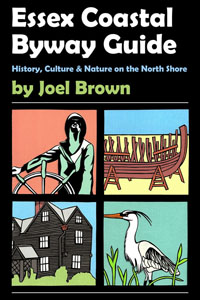
Yeah, Baxter McLean will be back, this time our unlikely folk-singing sleuth getting tangled up in the messy revolutionary politics of the 1970s, specifically the so-called United Freedom Front, which, in 1976, decided that bombing our happy little town, Newburyport Superior Court, was an interesting and effective way to protest whatever it was they were against (it seems so foggy now, like a bad dream) in the next Libertyport murder-mystery — Libertyport being that quaint, fictional-but-oh-so-familiar New England community where everyone knows everyone else, and their business, “an idyllic vision straight out of Norman Rockwell, but gay-friendly, with hybrid cars and flat-screen TVs,” as Joel Brown, the author, puts it. But you won’t find him, Baxter, kicking around the Rum House, or fending off the ferocious queries of local gossip/blogger Abigail Marks until next year. “If I make good on my promises,” says Brown, a North End resident, Boston Globe scribbler and author of “Mirror Ball Man” and “Mermaid Blues,” the two Libertyport/McLean mysteries. And he pretty much has to follow up on the series, seeing how he promised to kill off some lucky fan as a reward in his Kickstarter campaign to help finance “Essex County Byway Guide: History, Culture & Nature on the North Shore,” his current project, which has its coming out party next week at Plum Island Coffee Roasters — and his third book in as many years.

Thursday, October 18, 2012

Jozef Nadj: Hitting all the right notes

Jazz violinist Jozef Nadj’s got his funk on. He’s moving, grooving, despite the fact that he’s still getting used to real time after a trip back home, his first home, to Central Europe. So he rolls out of bed at the ungoldly hour of 5 in the morning, still hobbling around the house, nursing a foot injury from a pick-up soccer game, which delayed his return stateside by almost a week, leaving him barely enough time to prepare for the first day of classes at The Musical Suite, where the Lynn resident has taught for three years. He puts on some Maceo Parker and shakes off the cobwebs. Not that the violinist, who brings his band, the Jozef Nadj Fusion System, to the Firehouse next week, is especially heavy into the funk thing. Fact is, Nadj, whose name rhymes with "lodge," could, and would, play pretty much anything, as long as he finds something intriguing at its core, some challenge, something interesting to latch onto, to explore, an attitude perfectly illustrated by the classically trained musician’s two current, competing projects: the first, a rock album of original music somewhere in the vicinity, musically, of his favorite bands from back in the day: Guns N’ Roses, Red Hot Chili Peppers, Metallica — itself a significant departure from JNFS’s 2009 debut, "Digital World," which finds him in the neighborhood of Jean Luc Ponty (natch) and Miles Davis (the fusion years). And then there’s the other project, an album of tunes by Charlie Parker. By a band that does not have a tenor player — any saxophone, in fact. Yeah, Bird, the guy who all but invented the instrument. A god in jazz circles. Untouchable, unapproachable. An album with violin as its main weapon, its ax of choice. Granted, a hopped-up violin. Electric, with all the gear, pedals. Which adds another layer of controversy for purists.

Saturday, October 6, 2012

Amazing journey: Dunphy, Epomeo, the Dreadnaught

Melissa Dunphy is a classical composer with, um, some unusual influences, touchstones, like her stubborn, lingering obsession with Nine Inch Nails, which led her to re-imagine NIN’s “The Frail,” which she named “Variations on a Theme by Trent Reznor” and which she arranged as an Elizabethan madrigal, of course. And this is probably the most “normal,” the most standard repertoire thing she’s done lately. She’s 32, an Australian transplant. She’s a fellow at the University of Pennsylvania, a PhD candidate in composition, on a Benjamin Franklin Fellowship. She’s currently working on an opera based on the writings of Ayn Rand. Not the (yawn) important philosophical underpinnings of her fiction, what the Russian writer called objectivism. No, she’s zeroing in on Rand’s nasty, completely over-the-top depictions of sex that read like rape fantasy, or, in the case of “Fountainhead” hot-to-trot protagonists Howard Roark and Dominique Francon, sexual assault committed during the course of a home invasion. “I’m amazed that no one has made an opera out of it yet,” she says. Then, pausing, she adds, “Hopefully I won’t get sued.” 

Sunday, September 9, 2012

It ain't easy: Benefit concert leads to CD

Nothing worth a damn comes easy, does it? Just ask Gary Shane. The North Shore rocker, a fixture on the local music scene for, like, evah, decided to put together something for the National Multiple Sclerosis Society, a benefit concert. Raise some bucks for the organization, you know? About time, right? I mean, the guy has been living with MS since the mid-1980s, when his band, The Detour, broke with the monster hit "Shadow World," and over the past few years has organizaed multi-band benefits for disaster relief in Japan  and Indonesia, so it makes sense that he would do somethng a little closer to home, so to speak. So, in April, Shane put together a bill that combined local scenesters like EJ Ouelette and Crazy Maggy and Wade Dyce and Imojah and the Skylight Band with the crowd from Tavern at the End of the World, the Charlestown venue, Natalie Flanagan and Trusty Sidekick, as well as the current versions of Shane's Detour and Silvertones bands and the Heygoods, a country-soaked duo featuring Dave Champagne, who goes back with Shane to the pre-Detour days, who played with Boston blues legends, and Morphine prototype, Treat Her Right. And, for whatever reason, and we're not pointing fingers, the benefit didn't do quite as well as everyone had hoped, pulling in only $800. Which, although more than a little bit disappointing, financially, especially considering the amount of work that went into putting the thing together, did help finance a live recording from the show, which will also benefit MS. And that's when everything started falling off the rails and, unexpectedly, opened the door for something truly special.

Sunday, August 26, 2012

In the Cards: TITO's stunning 'Waste Land'

A beautiful fall day in the middle of summer at Maudslay State Park, making this August, however splendid, seem a bit sad, perhaps cruel. Not April cruel, with its false hope, coaxed from the dead land, from the forgetful snow, but cruel nonetheless. We’re walking along a damp, fragrant path to the performance site – on time for once, early, in fact, without a care, so it becomes a lovely, leisurely stroll, a point unto itself. We come across a small crowd where the path veers away, lazily, towards the river. Which is strange. Usually you walk right to the “stage” and pull up a bit of lawn. Something else is going on. Obviously. So we wait with the others. As the minutes pass, we debate whether this is part of the production, our wait a metaphor for the uneasy, potent concept of not knowing, about uncertainty, about the future, about life, about death, which lies at the heart of “The Waste Land,” the T.S. Elliott poem, perhaps the most celebrated poem in Western literature, one that has been re-imagined for the stage by Theater in the Open and directed by Stephen Haley, probably best known for his productions of all things Beckett, but whose edgy, vivid, stripped-down production of Sartre's “The Flies” last year set an impossible standard for the future. And this production, an adaptation of a dense, modern poem that is about everything, including nothingness, that, in itself, does not cry out for the stage, that is all wrong for the stage, would certainly pose the same sorts of challenges. Perhaps more, seeing how it's just 400-plus lines, including the Latin opening and the Sanskrit ending, one that takes maybe 20 minutes to read and a lifetime to understand, with no immediately obvious narrative.

Sunday, August 12, 2012

Fan-tastic: Bruisers back together ... for one night

Face it, it’s a fact of life. Sooner or later, you’ll have to drive too far and pay far too much money to see a band — you know, someone from back in the day, one of those bands that struck a nerve, that makes your heart go thumpa-thumpa still, that makes you grit your teeth and  feel those feelings again, the ones that made you feel alive, lighting you up in a way you barely remember now, with the mortgage and health insurance to deal with, right? Even if you weren’t really there, like Dropkick Murphys frontman Al Barr intimated in an interview about, among other things, the Bruisers, the Portsmouth/Newburyport punk band he founded back in 1988, a band that bashed its way out of regional obscurity with a brutal, punishing, as-hard-as-you-can-get street punk sound, a band that built a name for itself here and a virtual cult-status in western Europe. Which is not to say they ever achieved mass popularity of any sort, because they didn't. Despite the legion of fans the Bruisers have now. Which was Barr’s point exactly when he was talking about the last Bruisers reunion. Which was seven years ago, at this point, when the band filled the Roxy, drawing close to 1,000 fans — unheard of in the day, like five times what the band would get, on a good day, back in the day. ”It's cool to like a band when they don't exist anymore, as long as they're not popular," he said earlier this year in an interview for the gimmenoise blog.

Monday, August 6, 2012

It's in with the new at NCMF

What's new with the Newburyport Chamber Music Festival, the intimate classical music series with a rock and roll attitude, as it digs into its second decade? Plenty, says NCMF Artistic Director David Yang in an e-mail exchange from Calabria, Italy, in the Bay of Naples, where the violist chills, so to speak, every summer before the Port music series kickoff, at Festivale d’alla Musica da Camera d’Ischia, a week-long chamber music festival and intensive workshop where Yang has been a coach and performer for years — a cool retreat, he says,  but “hot as hell, actually,” he says, “but a dry heat,”  not that dry heat is much of a comfort. New? There will be new players, in the festival quartet, which will feature two new violinists, and at large, with two hired guns in the house to perform the much-loved Brahms Sextet, among other pieces. There will be new venues, as organizers reach across the river into Carriagetown for its first-ever non-Port concert, a performance benefiting the steeple restoration fund for the historic Union Congregational Church, as well as an open rehearsal at the 14 Cedar Street Artist Studios.  As in the past, there will be a world premiere, another piece highlighted by local texts, this one with Port poet Rhina Espaillat’s  “Three Tenses of Light,” inspired by the paintings of Ipswich artist Andrew Anderson-Bell, which will be lit up by Philadelphia composer Andrea Clearfield, who composed  it specifically for the Port-based  Candlelight Chorale, a 30-voice chorus. Which is certainly new for NCMF.